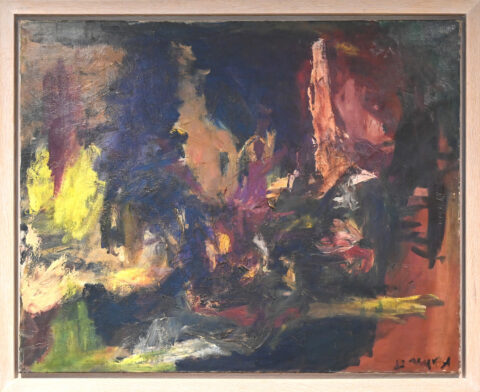
Erich Kahn
Artist’s Statement
Much of Kahn's work has been lost. The main reason being he belonged to what came to be known as the "Forgotten Generation" of German Jewish Expressionism-influenced artists born at the beginning of the 20th century, whose careers were hindered by the ascension of Nazism. Forced into exile to survive, they found themselves forever bereft of their identity, "caught between yesterday and tomorrow
The Berardo Collection has acquired a large part of Erich Kahn's body of work, which testifies to the richness of a life that even surpasses the biography
The Berardo Collection Museum (in Portuguese: Museu Colecção Berardo) is a museum of modern and contemporary art in Belém, a district of Lisbon, Portugal.
Biography
Erich Kahn (1904–1979) was a German Expressionist, and a survivor of the Nazi persecution of Jews and Gypsies during the events that led to World War II.
He was born in Stuttgart and lived in Germany until, persecuted by Nazis, he found himself imprisoned at the Welzheim concentration camp. After taking refuge in England, he was interned for a while at Hutchinson Camp, on the Isle of Man. He died in London, at the age of 75.
While still a student at the Stuttgart Art Academy, Kahn was strongly influenced by the Expressionist aesthetic of the local Uecht Gruppe. And although he studied in the Paris ateliers of Leger and Ozenfant during the 20s he remained an Expressionist both in spirit and in practice throughout his life. Fashion and politics were of course against him during the 30s, both as a man and an artist, and the Berliner Juedische Museum’s exhibition ‘Reichsausstellung Juedischer Kuenstler’ (April-June 1936) was the last time he exhibited in Germany. Following Kristallnacht, Kahn, with many other Stuttgart Jews, was imprisoned in Welzheim, the local Concentration Camp. That was an unforgettable experience, but one which his artistic, Expressionist temperament was able to digest in a series of powerful etchings.
He was released on condition that he emigrated and a British relation guaranteed him a place in England. Between July 1940 and April 1941 he was interned in Hutchinson Camp on the Isle of Man, where he continued to draw. Following his release, spasmodic support from fellow émigré artists and dealers and from the Hampstead based ‘Free German League of Culture’ enabled him to continue working and he attended the life drawing sessions held in the Clifton Hill studio his of old friend the sculptor Paul Hamann. It was, in all probability, there that these drawings were made.
Influences
Expressionist aesthetic of the local Uecht Gruppe
Exhibitions
Berliner Juedische Museum’s exhibition ‘Reichsausstellung Juedischer Kuenstler’ (April-June 1936 - last time he exhibited in Germany)
One Man Exhibitions:
1956: Redfern Gallery. 1958: Drian Gallery. 1960: Instit fur Auslandsbeziehungen, Stuttgart. 1960: Drian Gallery.
Group Exhibitions:
1922, 1953: Stuttgart. 1923, 1936: Berlin. 1941, 194: Leger Galleries. 1943: Whitechapel Art Gallery. 1945, 1949: Hampstead Artist’s Council. 1947: UNESCO. 1954: Redfern Gallery. 1955: Tooth Gallery. 1957 Hanover Gallery. 1957: Les Surindependents Paris. 1958: Bruges Biennale. 1968: Prix Marzotto. 1986 London (Camden), Berlin, Oberhausen: ‘Kunst im Exil in Grossbritannien (1933-1945)’ 1987: John Denham Gallery ‘Émigré Artists’. 1989: John Denham Gallery. 2005 ‘Erich Kahn’ Berardo Collection, Sinta Museum of Modern Art, Portugal.
Showing the single artwork