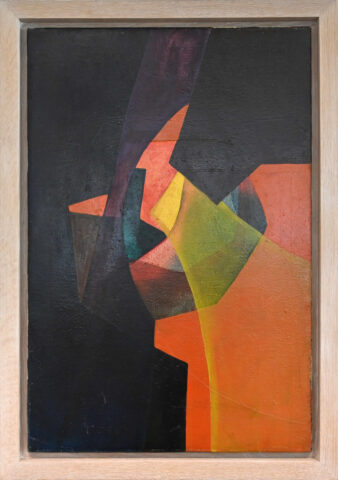
Joseph Lacasse
Biography
1894
Born in Tournai, Belgium
1910
Completed his first abstract and Cubist compositions
1914
First exhibition in Brussels
1912–1918
Studied at the Ecole des Beaux-Arts in Tournai
1921
Visited Italy where he painted his Motherhood series
1920–1922
Studied at the Académie Royale des Beaux-Arts in Brussels
1922–1923
Travelled to Brittany and Spain
1925
Moved to Paris where he met Robert Delaunay
1937
Invents an aesthetic theory of the abstract
1930–1939
Lacasse moves towards Tachism
1940
Joined the Liberation French forces in England
1943
Became professor of sculpture and ceramics in Stoke-on-Trent
1947
At the end of the war he returned to Paris and became a French citizen
1975
Died in Paris, France
Joseph Lacasse (Belgian 1894–1975) is considered one of the most unique abstract painters of the École de Paris. Lacasse executed his first abstract drawing at the age of 12, and by 1910, was painting abstract oils. In 1912, Lacasse entered the École des Beaux-Arts of Tournai, where he explored a number of different styles, including his own brand of Cubism that he called "constructive."
In 1921, Lacasse travelled to Italy, where he produced the Motherhood series, which focused on religious works and workers, and was done in a realistic style. In 1925, he relocated to Paris, where his association with Robert Delaunay greatly influenced his use of colour.Influences
his association with Robert Delaunay greatly influenced his use of colour.
Showing the single artwork